

Last Updated: October 27, 2026
Quick Summary
A stuck lift chair is usually caused by a power, outlet, cord or remote problem rather than a broken motor. Unplug the chair, check the outlet and cord, reseat the hand-control cable, then reset the chair by unplugging it for about 30 seconds.
- Unplug the chair before opening covers, touching wiring, or reaching under the seat.
- Test the outlet with another device, such as a lamp or phone charger.
- Replace remote batteries with fresh ones, even if the remote still lights up.
- Unplug the chair for about 30 seconds, then retry the reset, no more than two or three times.
- Stop and call a technician if the motor grinds, clicks, burns, or the chair moves only partway.
Table of Contents
- Safety Precautions Before You Troubleshoot a Stuck Lift Chair
- Start With the Power Supply: Outlet, Cord and Transformer Checks
- Check the Remote and Hand Control When the Lift Chair Is Not Responding
- Reset the Chair and Fix a Lift Chair Stuck in the Reclined Position
- Manual Lowering, Repair Costs and When to Call a Technician
- Frequently Asked Questions
This guide walks through checks to consider when a lift chair is stuck, starting with common questions.
A stuck lift chair usually means the chair has stopped moving in one direction, whether it will not lower, will not recline fully, or stays partly raised. Most causes are electrical or control-related, so you can check them yourself with basic tools.
Safety Precautions Before You Troubleshoot a Stuck Lift Chair
Before you touch anything, take a few steps to keep yourself safe. A chair that is stuck can still move without warning when power returns.
- Unplug the chair before you open any cover, touch the wiring, or reach under the seat.
- Clear the area around the footrest and base so nothing gets pinched when the chair moves.
- Ask someone nearby to stay with you, especially if you have balance or mobility concerns.
- Keep your hands and feet away from the mechanism while power is connected.
Watch out: Never force a stuck chair by pushing on the footrest or pulling the backrest. Forcing the mechanism can strain the motor and damage the lift arms.
Some checks need power on, such as testing the remote. Plug the chair back in only when a step tells you to, and unplug it again before you move on.
Start With the Power Supply: Outlet, Cord and Transformer Checks
Most stuck lift chairs have a power problem rather than a broken motor. Start with the simplest check and work outward. To see whether your model includes a battery backup system that can help during an outage, review the FAQ answers.
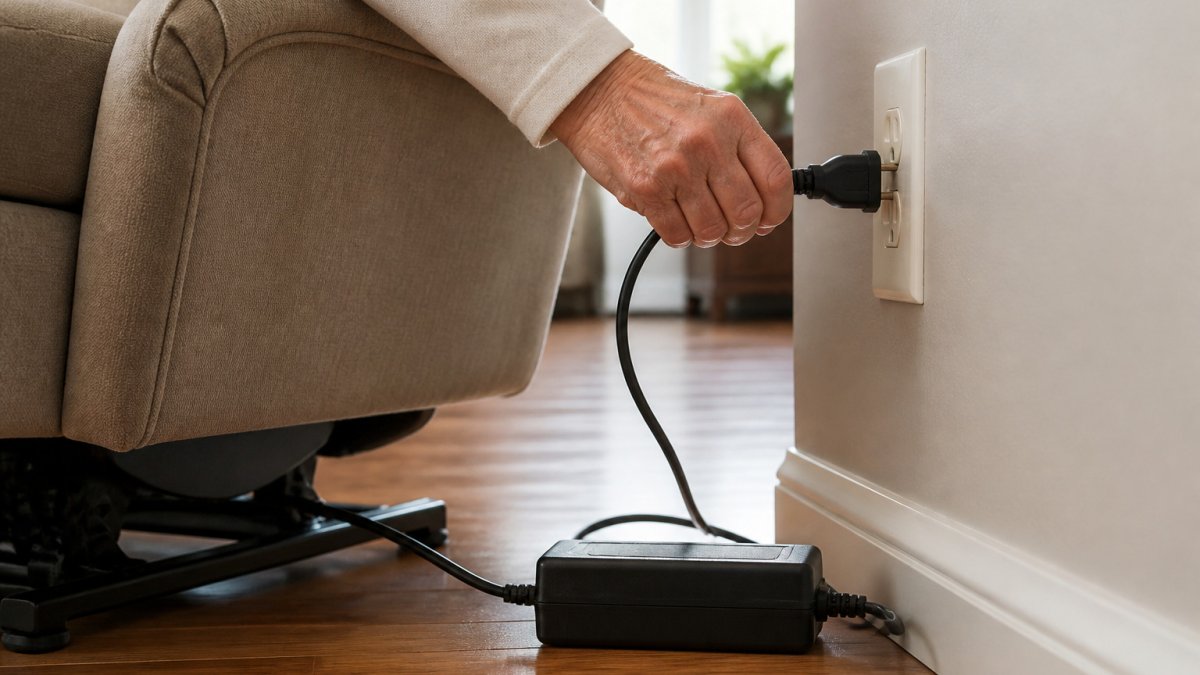
First, confirm the outlet works. Plug a lamp or phone charger into the same outlet to test it. If that device does not work, the problem is the outlet or the breaker, not the chair.
Next, inspect the power cord. Look along its full length for cracks, pinches, or scorch marks. Make sure the plug sits firmly in the outlet and that the connection at the chair's power box is tight.
Then check the transformer, the small block between the plug and the chair. A transformer that is warm to the touch or has a burnt smell may have failed.
- Confirm the outlet works with another device
- Check the cord for damage along its full length
- Tighten the plug at the outlet and at the chair
- Look for a warm or burnt-smelling transformer
If the power supply checks out, the chair will still not respond to controls. That points to the remote, which is the next place to look.
Check the Remote and Hand Control When the Lift Chair Is Not Responding
A chair that will not move at all often has a remote or hand-control problem, but "the remote is broken" is only one of several possibilities.
Step 1: Confirm the remote is receiving power. Replace the batteries with fresh ones, even if the remote still lights up. A weak battery can power the display but not the motor signal.
Step 2: Reseat the hand-control cable at both ends. Unplug the chair first. Trace the cable from the remote to the chair's control box or junction point.
Step 3: Inspect the cable along its full length. A cable that has been stepped on, pinched under the chair, or bent sharply near the connector can break inside its sleeve.
Step 4: Test the remote from a different position. Some owners find the remote is fine but the signal is blocked or the chair is in a fault state.
The steps below separate a dead remote from a wiring or control-board fault, in the order the article recommends.
| Step | What to do | Time or frequency |
|---|---|---|
| 1. Confirm remote power | Replace batteries with fresh ones | Before other checks |
| 2. Reseat cable | Unplug chair, push connectors firmly back | Each connector |
| 3. Inspect cable | Check full length for kinks or exposed wire | Full cable length |
| 4. Test from distance | Move a few feet away, press once, wait | A few seconds between presses |
| 5. Isolate the fault | Fresh battery and reseat failed: suspect wiring or board | If no movement restored |
Reset the Chair and Fix a Lift Chair Stuck in the Reclined Position
When a chair is stuck reclined, a reset often clears the fault. If you are weighing a newer model, see the Infinite Position lay-flat, recline and lift chair for a design with a repair-friendly mechanism and battery backup.
To try a reset, unplug the chair for about 30 seconds. Plug it back in, then press and hold the reset button or the reclining control in the direction the chair needs to move.
If the chair is stuck partly reclined, a short power cycle sometimes frees the mechanism. Repeat the reset once or twice before you assume a fault.
Watch out: Do not repeat resets more than two or three times in a row. Repeated attempts can overheat the motor. If the chair does not respond after two tries, stop and move on to the next section.
A reset works best when the stuck position is caused by a power glitch.
Manual Lowering, Repair Costs and When to Call a Technician
When the chair stays raised or reclined, getting the user out safely is the first priority. Most lift chairs have a manual release or emergency lowering feature, but the method varies by model. Check the owner's manual for the release location, usually under the seat or on the side of the base. Pull or turn the release slowly; the chair will lower under its own weight, so keep one hand on the armrest and move carefully. If the release does nothing, do not force it. For a chair stuck reclined, some models allow the backrest and footrest to be returned manually by lifting the footrest and pushing the backrest upright while the release is engaged. If the user cannot be moved safely, call for help rather than risk a fall. To arrange service or request a repair quote, contact Mega Motion Lift Chairs.
When to stop troubleshooting and call a technician.
- The manual release does not work or you cannot locate it.
- The motor makes a grinding, clicking, or burning noise.
- The chair moves only partway in one or both directions.
- You see damaged wiring, a burnt smell, or scorch marks at the control box.
- The chair resets but fails again within a short period.
- The user is unable to exit the chair safely.
Repair costs and service decisions.
Parts compatibility. Replacement remotes, transformers, batteries, and actuators are model-specific. Identify the chair's model and serial number from the label under the seat or on the base, and match parts against the manufacturer's parts list. An incompatible remote or transformer can plug in but fail to operate the chair, and an incorrect actuator can damage the lift mechanism. When in doubt, order through the manufacturer or an authorized dealer rather than a generic aftermarket part.
Frequently Asked Questions
Why is my lift chair stuck in the reclined position?
A lift chair usually stays reclined when the motor cannot complete its travel, most often because of a power interruption, a tripped reset, a loose connection, or an obstruction under the chair. Start by confirming the chair is plugged into a working outlet and that the power box is seated firmly. Then press the reset button and try the hand control again. If the chair still will not move, inspect for objects blocking the base or a damaged wire, and lower the chair manually only if the manufacturer's instructions permit it. Repeated stalls point to a motor or actuator fault that needs qualified service.
Where is the reset button on an electric recliner?
On most electric recliners and lift chairs, the reset button sits on the control box or power box underneath the chair, near where the power cord enters, though some models place it on the side panel or behind a small cover. Consult the manufacturer's manual for your exact model before searching, since locations vary. To reset, unplug the chair for about 30 seconds, plug it back in, and wait a moment before using the hand control. Avoid pressing the reset repeatedly, as frequent cycling can mask a fault that needs repair.
What should I check if my lift chair remote is not working?
Begin by replacing or checking the remote batteries, then confirm the hand control cable is fully connected at both ends. Inspect the cord for kinks, cuts, or pinching under the chair frame. If the chair responds to other controls or the remote still fails, try power cycling the chair to clear a temporary fault. Remote problems that persist after these steps often trace to a failed hand control or a damaged wiring harness, and a technician or the manufacturer can test the components to confirm which part needs replacing.
When should I call a lift chair repair technician?
Call a qualified technician if the chair remains stuck after you have checked the power supply, remote, and reset button, or if you notice burning smells, sparking, a hot control box, or visible damage to wiring. Stop troubleshooting and unplug the chair if any of these occur. Also seek service if the chair makes grinding or straining noises, lifts unevenly, or stalls repeatedly. Check your warranty terms before paying for repairs, since covered faults may be fixed at no charge, and ask the manufacturer for service options for your model.
